

By Julian Barton, EGM | Feedback ASAP | feedbackasap.com
Ask a business running a Voice of Customer program whether they are measuring the right things, and most will say yes. Ask them whether that measurement is actually growing the business, and the room tends to go quiet. That gap, between having a measurement program and having a growth program, is the single biggest thing missing from most CX strategies today.
It came through clearly in the questions we fielded after our recent webinar. Almost nobody asked us how to get a better score. What people wanted to know was what to do once they had one. How do you take a number and turn it into something that actually moves sales, retention and advocacy? That curiosity, and the shift in thinking it represents, is what this article is written to unpack.
It’s one thing to have a Voice of Customer program gathering scores. It’s a different thing entirely to have a Voice of Customer growth program.
A Measurement Program Is Not a Growth Program
The distinction sounds subtle until you sit with it. A measurement program tells a business where it stands. It runs a survey, produces a score, tracks that score over time, and reports it up the chain each month. Done well, it is accurate. It is also, on its own, close to useless for deciding what to do next. This is the fundamental split between a measurement program and a growth program, and everything that follows in this article builds on it.
A growth program starts from the same customer voice and takes it somewhere different. It goes past the score and into the sentiment and the themes sitting underneath it. It translates that sentiment into a specific action. Then it translates that action into growth, measured in retention, advocacy, spend and the sales numbers that leadership actually cares about. Same raw material, completely different destination.
Deloitte’s 2026 Global Retail Industry Outlook puts a number on this: up to 40% of brand value perception now comes from non-price factors like service, checkout ease, loyalty and employee interactions, not price. The businesses turning that into growth are the ones acting on it, not just measuring it.
Think about the difference between a small car and a four-wheel drive. Both will get you down the highway perfectly well, and side by side in a car park you might struggle to tell them apart. Only one of them is built to get you anywhere: over rough ground, in bad weather, when the terrain gets difficult. A measurement program is the small car. It is efficient, familiar, and on a good day it does the job asked of it. A growth program is the four-wheel drive. It is engineered from the ground up to take a business places a score alone never will.
To be clear, this is not an argument for dropping NPS. NPS stays. It is a well-understood, well-trusted number and boards like it for good reason. What changes is what sits around it. Diagnosing NPS, rather than simply reporting it, means adding a tangible growth dimension to a number that was only ever built to be a rearview mirror. You still need the mirror. You just cannot steer the business by it alone.
Six Pillars, One System
Everything we have just described only works if it is built as a system, not a collection of good ideas. We think about that system as six pillars, the engine of a growth program, and the point of building them this way is a simple one: miss any single pillar and the engine does not get you there. All six need to be working together.
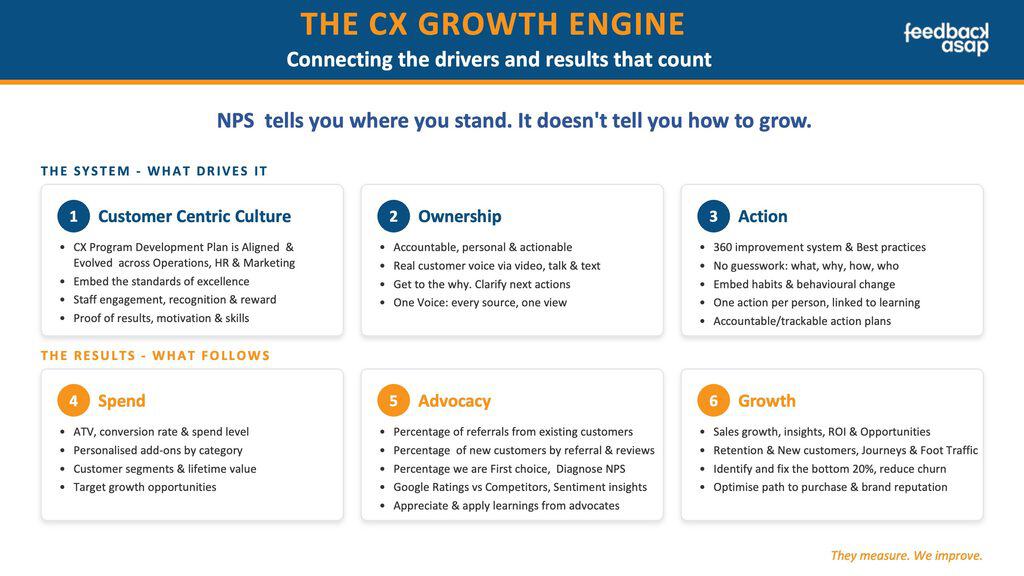
The first three pillars are what drive the system. They are the conditions that have to exist before growth is even possible:
- Customer Centric Culture: operations, HR and marketing aligned around the same standards of excellence, with staff engagement, recognition and reward built in from the start. Culture is not a poster on a wall. It is proof of results, motivation and skill, visible in how a team actually behaves.
- Ownership: real customer voice, gathered via video, talk and text, not reduced to a single number standing in for it. This is where a business gets to the why behind a result and clarifies exactly what needs to happen next, with every source of feedback, One Voice, sitting in one place rather than scattered across six systems.
- Action: a 360-degree improvement system built on best practice, not guesswork. It answers what, why, how and who for every team, embeds new habits and behavioural change, and gives each person one accountable, trackable action plan linked directly to learning, not a report nobody reads.
The second three pillars are the result. They are what shows up once the first three are genuinely in place, not before:
- Spend: average transaction value, conversion rate and spend level lifting because personalised add-ons, customer segments and lifetime value are finally being managed with intent rather than left to chance.
- Advocacy: the percentage of customers who are referring you, choosing you first, and leaving you strong reviews, tracked alongside NPS rather than instead of it, so leadership can see the two moving together.
- Growth: sales growth, insight, ROI and new opportunities, retention and new customer journeys lifting, the bottom 20% of performers identified and fixed, churn reduced, and the whole path to purchase and brand reputation optimised as a result.
Put simply: get the system right, and the result follows. Chase the result without building the system underneath it, and you are back to hoping a score moves on its own. That is what a growth program actually is.
The Seven Moments That Build Advocacy
Zoom in from the six pillars to the level of an individual customer, and there is a second pattern worth understanding: the seven moments that actually build advocacy inside a growth program, in the order they tend to happen. Every one of these is a point where a customer either starts trusting a business a little more, or starts trusting it a little less.
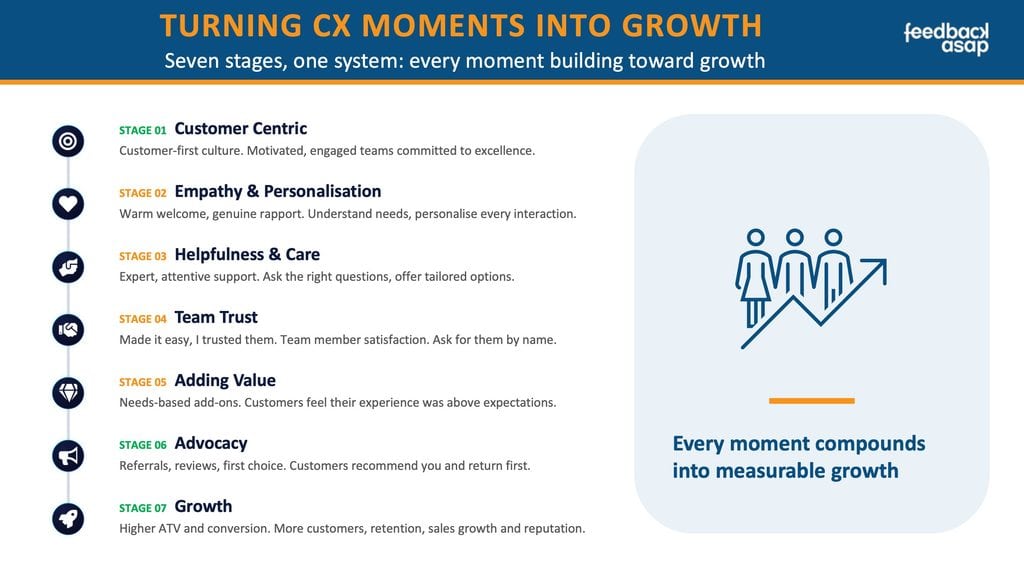
- Customer Centric: a customer-first culture, with motivated, engaged teams committed to delivering an excellence standard consistently, not occasionally.
- Empathy and Personalisation: a warm welcome and genuine rapport, where the team understands what this specific customer needs and personalises the interaction accordingly.
- Helpfulness and Care: expert, attentive support, asking the right questions and offering tailored options rather than a generic script.
- Team Trust: the customer feels it was made easy, feels they can trust the team member, and wants that same person to serve them again next time.
- Adding Value: needs-based recommendations offered at the right moment, so the customer feels the experience genuinely exceeded what they expected.
- Advocacy: the customer refers others, chooses this business first, and leaves the kind of review that brings new customers in the door.
- Growth: higher average transaction value and conversion feed more customers and stronger retention, which in turn builds trust, sales growth and brand reputation.
Notice the shape of that list. It starts with culture and empathy, long before it gets anywhere near a sale. Growth is the last moment in the sequence, not the first. Businesses that try to shortcut straight to growth, without doing the work in the first five moments, are usually the ones wondering why their NPS has plateaued despite a genuinely committed team.
From Engagement to Growth: How It Actually Works Day to Day
The six pillars and the seven moments describe what has to be true for a growth program to work. The operating model underneath it is how a business actually gets there, week in, week out. We build every growth program around four stages: Engage, Solutions, Action and Growth.
- Engage: capturing the emotion, the context and the why, not just the score. Customers give feedback their way, by video, voice or text, and we gather it across every touchpoint. That richer, story-based feedback creates an emotional connection that a five out of ten never will. It makes customer feedback visible and real for a team, gets used in recognition, in meetings and at conferences, and builds the customer-first culture and empathy that everything else depends on.
- Solutions: no more guessing what to fix. This is program leadership, an improvement system, and best practice management, delivered through One Voice, a multi-channel platform covering QR, SMS, email and custom rules, alongside a Results Hub and mobile app. Purpose-built AI identifies the patterns, the priorities and the coaching focus for each team, integrating everything from retail and trade to call centre and delivery, so the diagnosis replaces the noise rather than adding to it.
- Action: turning insight into a daily habit, not a reporting exercise that lives in an inbox. This stage summarises how customers feel, identifies and targets the top improvement opportunity for each individual and team, calculates the potential ROI, and sets priorities accordingly. It gives absolute clarity on what action to take next, tracks a quarterly focus area through to completion, and celebrates the most improved and the most consistent performers, because recognition is what makes the habit stick.
- Growth: turning improved experience into results that count, across four areas at once. Customer impact: higher NPS, loyalty, advocacy and social ratings. Team impact: greater empathy, higher motivation and stronger capability. Commercial impact: increased sales, average transaction value and retention. Operational impact: better efficiency, fewer preventable issues and a clearer return on investment. Customer insight becomes a growth engine, not a quarterly report.
Getting past the score and into the sentiment and the themes is the real shift. Then it’s about showing a business how to translate sentiment into action, and action into growth.
What Changes First When You Make the Shift
Businesses moving from a measurement program to a growth program tend to notice the same thing first: meetings change shape. A measurement meeting spends most of its time agreeing on what the score was and speculating about why it moved. A growth meeting spends that time differently, because the why is already answered in the feedback itself, and the conversation can go straight to what a specific team or team member is going to do about it this week.
Store or team leaders stop guessing what to coach and start knowing. Customer feedback gets connected directly to the KPIs a business already tracks, sales, retention, foot traffic, so leadership finally has one unified view of what is actually driving performance, rather than a customer number in one report and a sales number in another with nobody quite sure how the two relate. Behaviour change becomes the daily operating rhythm of the business, not an initiative that gets a burst of attention after the annual results land and then quietly fades.
None of this requires ripping out what already exists. It requires the six pillars of a growth program sitting underneath what already exists, so the same customer voice a business is already collecting starts doing more work than it currently does. That is the real difference between a Voice of Customer program and a Voice of Customer growth program: not the source of the data, but everything that happens to it after it arrives.
Where Are Your Top Opportunities?
Every store or team we have worked with has a number one opportunity sitting inside their own feedback right now, the kind of opportunity a growth program is built to surface, usually one they already half suspect but have never had proven to them with real customer voice. Sometimes it is a single behaviour at the counter. Sometimes it is a gap between what the top 20% of stores or teams are doing and what everyone else is doing. Sometimes it is simpler than either: nobody has ever told a specific team member, specifically, what to do differently this week.
That is the question worth sitting with before the next leadership meeting. Not what was our score this quarter, but where is our biggest opportunity hiding right now, and who owns fixing it. A growth program exists to answer that question every week, for every team, not just once a year when the annual survey results land.
Worth a Conversation?
If the webinar left you curious about what a genuine growth program looks like inside your own business, this is a good place to keep that thinking going. Feedback ASAP brings 25 years of program leadership, an end-to-end feedback system, and the six-pillar CX Growth Engine built to turn real customer voice into daily action, and daily action into growth. It’s what turns a Voice of Customer program into a genuine growth program.
Reach out to the Feedback ASAP team. We will listen first, and help you map a pathway for growth that fits your business, your culture, your customers, and the growth program you already have in place.
Frequently Asked Questions
What’s the difference between a measurement program and a growth program?
A measurement program tracks and reports customer feedback scores like NPS. A growth program goes further: it diagnoses the sentiment and themes behind the score, turns that into specific actions, and tracks the resulting growth in spend, advocacy and retention.
Should businesses stop using NPS?
No. NPS remains a well-trusted number boards rely on. What changes is what sits around it: diagnosing NPS rather than simply reporting it, so the number becomes a growth input rather than only a rearview mirror.
What are the six pillars of the CX Growth Engine?
Three pillars drive the system: Customer Centric Culture, Ownership and Action. Three are the results that follow: Spend, Advocacy and Growth. Missing any one of the six means the system doesn’t deliver.
Where should a business start if it wants to move from measuring to growing?
Start with the feedback already being collected. The shift isn’t about new data sources, it’s about diagnosing the sentiment and themes already sitting inside existing customer voice, then linking that directly to a trackable action for each team.