

By Julian Barton, EGM | Feedback ASAP | feedbackasap.com
Customers do not wait for your CX program to catch up.
Customer expectations rise a little more every year. A faster answer. A warmer welcome. Someone who remembers what they said last time. Their benchmark is not your closest competitor. It is the best experience they had this week, anywhere.
Most CX programs were built to measure that experience, and they do it well. Scores arrive on time. Dashboards look sharp. Sentiment is tracked and themes are tagged. Yet in the store, on the call or on the floor, very little changes. Customer expectations keep rising. The business stays where it is.
This article looks at why rising customer expectations are outpacing delivery, what it costs, and how to build a program that helps everyone go up a gear. It is also the thread running through Phil Prosser’s webinar on Thursday 15 October.
The Problem: Customer Expectations Keep Raising the Bar
Business leaders can feel it. Pitcher Partners’ Business Radar 2026 found that 65% of businesses report customer expectations have increased over the past two years.
Customers feel it too, and they are not convinced businesses are keeping up. The State of Customer Experience in Australia 2025, from CPM Australia and Swinburne University’s CXI Research Group, found that around two in three Australian consumers believe companies place little or only moderate importance on delivering outstanding service.
Read those two findings together. Businesses know customer expectations are climbing. Customers do not believe the experience is climbing with them. That space between what customers expect and what they actually receive is where loyalty is lost.
The same research found that 94% of Australian consumers have stopped buying from at least one company after a negative experience. They rarely announce it. They simply go.
Closing the gap between customer expectations and delivery is the real job of a CX program. Not describing it. Closing it.
Customer expectations rise every year. Most CX programs just measure how far away they are.
Where CX Programs Get Stuck
Most programs do not fail through lack of effort. They stall at four predictable points. Each one feels like progress. None of them changes behaviour on its own. We cover the wider picture in our article on why CX programs fail.
Stuck on the score
A score is a useful starting point. NPS, CSAT and satisfaction ratings tell you where you stand and whether you are moving. The trouble starts when the score becomes the goal. Meetings revolve around the number. Targets are set on the number. Teams are told to lift the number, with no clear idea how.
A score is a lagging indicator. It reports the past. It does not tell a store or team what to do differently on Monday. Nor does it show how far customer expectations have moved since the last survey.
Stuck in the data
Then comes the data. Surveys, reviews, call centre logs, HR surveys, social comments, dispatch and finance reports. Each owned by a different person. CX, Operations, HR and Marketing all pointing in different directions, each with a slightly different view of the customer.
We call it data rich, action poor. Leaders are overwhelmed with information and starved of clarity on what to do next. Insights live at head office. They rarely reach the frontline, and when they do, they arrive as a long report nobody has time to read.
Stuck on sentiment
Sentiment matters. Knowing how customers really feel, positive, negative and neutral, gets you to the why behind the score. Real customer voice, by video, talk or text, in the customer’s own words, carries emotion that a rating never will.
But sentiment on its own is a description. “Customers feel frustrated at checkout” is accurate. It is not an instruction. A team member looking at a sentiment chart still has to decide what to do with it. Most do not. They go back to the shift.
Stuck on themes
Themes are the next step up, and AI does this well. Thousands of comments are grouped into what customers love and what concerns them. That is useful and necessary.
It is still not enough. Ten themes across the business is a list, not a priority. A theme that nobody owns, nobody is trained on and nobody follows up is simply a more sophisticated way of knowing something and doing nothing.
Here is the pattern. Score, then data, then sentiment, then themes. Each layer adds understanding. None of them adds action. Meanwhile customer expectations keep rising, and the people who can actually close the gap, frontline teams and their leaders, are left to work out the next step for themselves.
Understanding customers is not the same as serving them better.
The Impact: The Gap Is Already Inside Your Business
When a program stalls at measurement, the gap between customer expectations and delivery is hard to see at first. Averages hide it. Look inside the business and it becomes obvious.
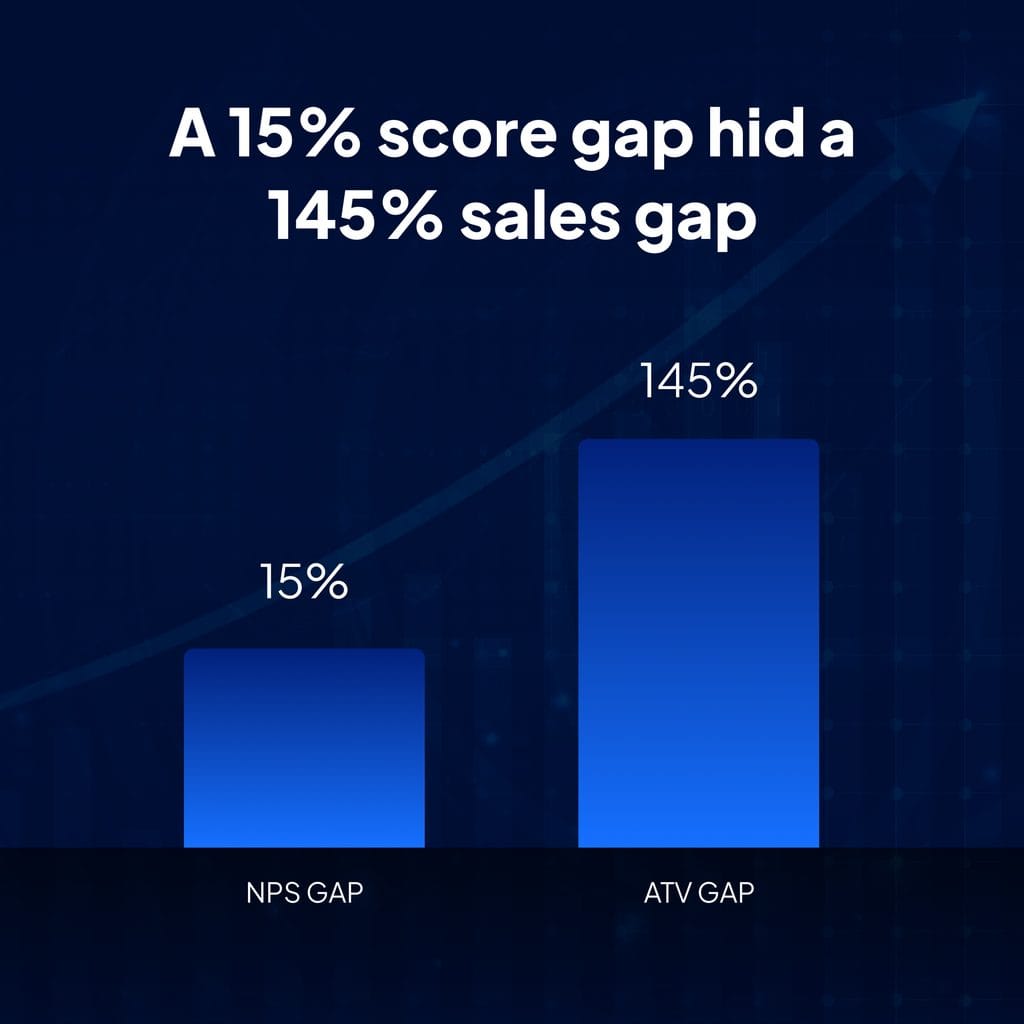
In one large multi-site retail group, the top 20% of stores delivered an average transaction value (ATV) 145% higher than the bottom 20%. Same brand. Same products. Same customer promise. The NPS gap between those same two groups was just 15%.
Read that again. A 15% score gap sat on top of a 145% sales gap. The score said the stores were broadly similar. The sales said they were in different worlds. A program watching only the score would have missed the biggest commercial opportunity in the business.
The difference was behaviour. Top stores used names, their own and the customer’s, more often (53% versus 33%), offered fitting room service more consistently (84% versus 63%) and suggested additional products more often (67% versus 50%). None of that is a mystery. All of it is coachable.
These moments also compound. In related Feedback ASAP analysis, a store or team that met every standard set the benchmark for transaction value. Miss two standards and ATV fell by 16%. Miss four and it fell by 28%. Each missed moment adds up across every customer interaction.
Now set that against rising customer expectations. A customer who expects more and meets a team that misses two or three standards does not write a complaint. They just buy less, or buy elsewhere.
The Action: Make It Easy for Everyone to Go Up a Gear
Closing the gap does not need more measurement. It needs the program to have a different job. Measurement is the starting line. Action is the race. Here is what that looks like in practice. It is the same shift we describe in our article on the customer experience improvement program.
1. Start with one voice, not six systems
Bring all feedback into one place: surveys, reviews, Google and Trustpilot, call centre, HR and staff voice. One Voice view of the customer across the business means CX, Operations, HR and Marketing work from the same truth. It is also the fastest way to see how customer expectations differ by store, channel and team. Let customers respond their way, by talking, typing or video, and keep it short. Three to four minutes is enough.
2. Give every store or team one number one opportunity
This is where themes become action. Not ten. One. Use AI to read the customer voice and show each store or team its top opportunity, then compare it with what the top 20% already do so the target is real and visible. A team trying to fix ten things fixes none of them.
3. Put a name against every action
An insight handed to “the team” is owned by nobody. Give each action to a named person. The store or team leader owns the theme. Specific team members own specific behaviours. The area or regional manager owns the support. Everyone knows what is expected of them this week, and why it matters.
4. Make the how as easy as the what
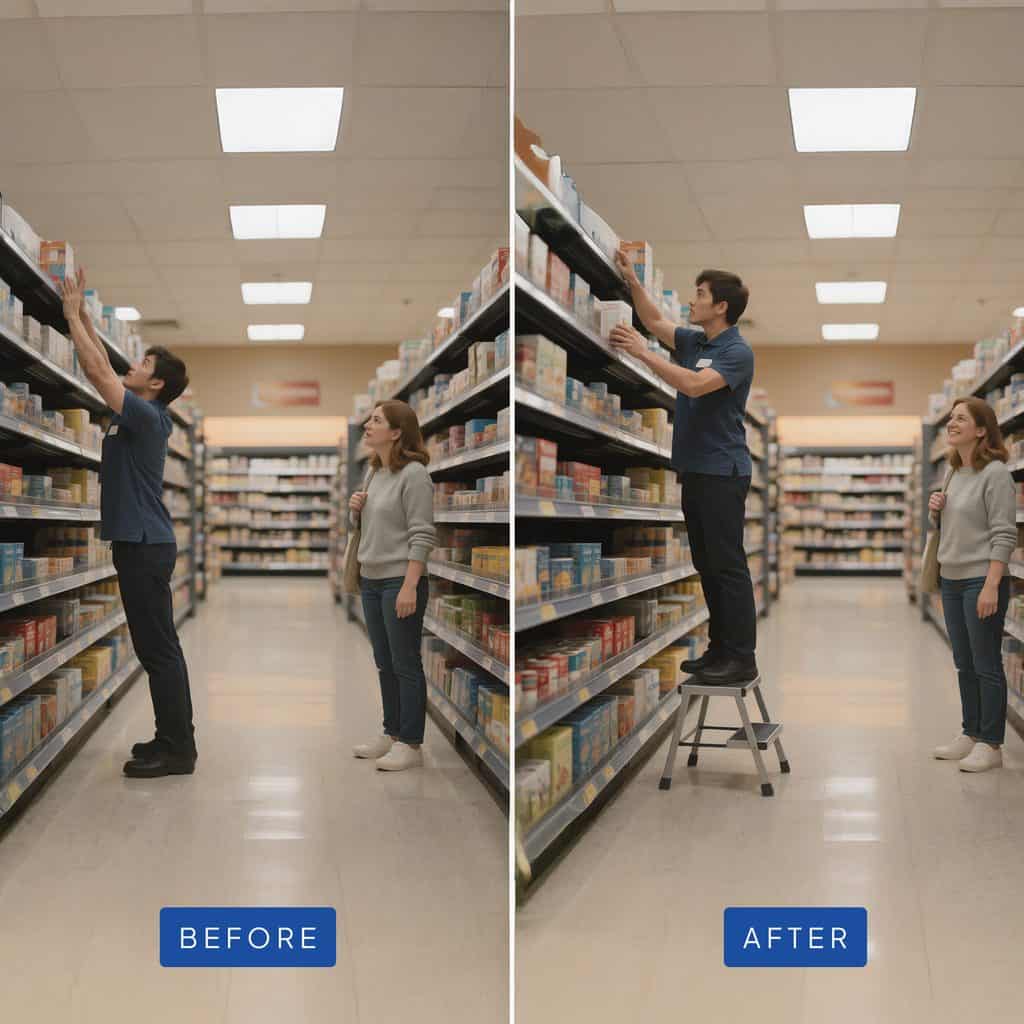
Generic training does not shift behaviour. Link each opportunity directly to short, personalised learning that can be completed in minutes, and share Top Tips from the best teams through short video. Remove the guesswork. When people know what good looks like, and are shown how to get there, they do it.
5. Build a weekly rhythm and recognise progress
Good intentions fade fast without a rhythm. Open the pre-shift briefing with a real customer comment. Agree what good looks like. Notice who does it well and say so, publicly. Recognition costs almost nothing and makes the behaviour stick. Review progress monthly, lift the bottom 20%, then move on to the next opportunity.
6. Climb from reactive to proactive to predictive
A reactive program responds after the complaint. A proactive program uses insight to improve before the score drops. A predictive program spots issues and opportunities early enough to act ahead of changing customer expectations. In our experience, most businesses sit at reactive. The aim is to climb, one step at a time, and every step depends on action habits rather than another dashboard.
It’s not what you score that counts. It’s how you make the leap into action.
The Outcome: Delivery Rises to Meet Customer Expectations
When action becomes a habit, the gap closes from the inside. Here is what that has looked like for Feedback ASAP clients:
- Upsell rates up 31% and NPS up 18% over 12 months, for a national telecommunications retailer.
- 111% higher sales growth in the top 20% of stores, for a global appliance business.
- NPS up 72% in under eight months, for an international optical retailer.
- Conversion rate up 36%, for a specialty retailer.
- 78% of new customers coming from advocates, referrals and Google reviews, for a national auto servicing business.
Each result came from the same place. Teams knew what customers were saying. They knew the one thing to do differently. They were shown how, and backed to do it every week.
Customer expectations will keep rising. For a business that has built the habit of action, that is not a threat. It is the reason the habit pays back, because every lift in delivery now has a customer waiting to notice it.
Phil Prosser takes this further in his webinar on Thursday 15 October, including why advocacy is where the gain compounds. If this article raised questions about your own program, it is a good place to keep going.
Questions to Ask Before Your Next CX Review
- Do we know why customers feel the way they do, or only what they scored us?
- Does every store or team have one clear number one opportunity?
- Does every action have a named owner and a short, easy way to learn the how?
- Do we know the gap between our top and bottom 20%, and what drives it?
- Will we know within weeks whether behaviour has changed?
Worth a Conversation?
If your program is strong on measurement but customer expectations are outpacing what your teams deliver, this is a good place to start. Feedback ASAP brings 25 years of program leadership and an end-to-end system built to turn customer voice into daily frontline behaviour. We will listen first, then help you map a Pathway for Growth that fits your business, your teams and your customers.
Sources: Pitcher Partners, Business Radar 2026. CPM Australia and Swinburne University CXI Research Group, The State of Customer Experience in Australia 2025.
Frequently Asked Questions
Why are customer expectations rising?
Customers compare every experience with the best one they have had anywhere, not just with your direct competitors. As more businesses personalise, speed up and simplify, customer expectations rise for everyone. Businesses that deliver the same experience as last year are effectively going backwards.
Why do most CX programs struggle to keep pace with customer expectations?
Most programs are built to measure, not to change behaviour. They produce scores, sentiment and themes, but stop short of giving each store or team a clear priority, a named owner and an easy way to learn what to do differently.
What is the difference between sentiment, themes and action?
Sentiment shows how customers feel. Themes group what they say into patterns. Action is what a named person does differently as a result. Sentiment and themes explain the problem. Only action closes the gap between customer expectations and delivery.
How do we start closing the gap between customer expectations and delivery?
Start with the feedback you already collect. Identify the one opportunity that matters most for each store or team, give it a named owner, link it to short learning and review progress weekly. Compare your top and bottom 20% so the opportunity is visible.