
By Julian Barton, EGM | Feedback ASAP | August 2026
In this Phil Prosser NPS interview, Feedback ASAP’s Julian Barton asks the Founder and CEO why a rising NPS score doesn’t guarantee growth, and what actually does.
I have worked alongside Phil Prosser for a total of 17 years, across two different companies. In all that time, I have never heard him talk about NPS as a goal. He talks about behaviour change. He talks about companies being “data-rich, action poor.” He talks about the real voice of customer changing how a store manager thought about their job the very next morning.
With Phil stepping in front of a live webinar audience on August 26, I sat down with him for a candid conversation about where CX programs go wrong, why advocacy is the metric he thinks most businesses are ignoring, and what it actually takes to build a program that drives growth rather than just reporting on it.
This is a lightly edited version of that conversation.
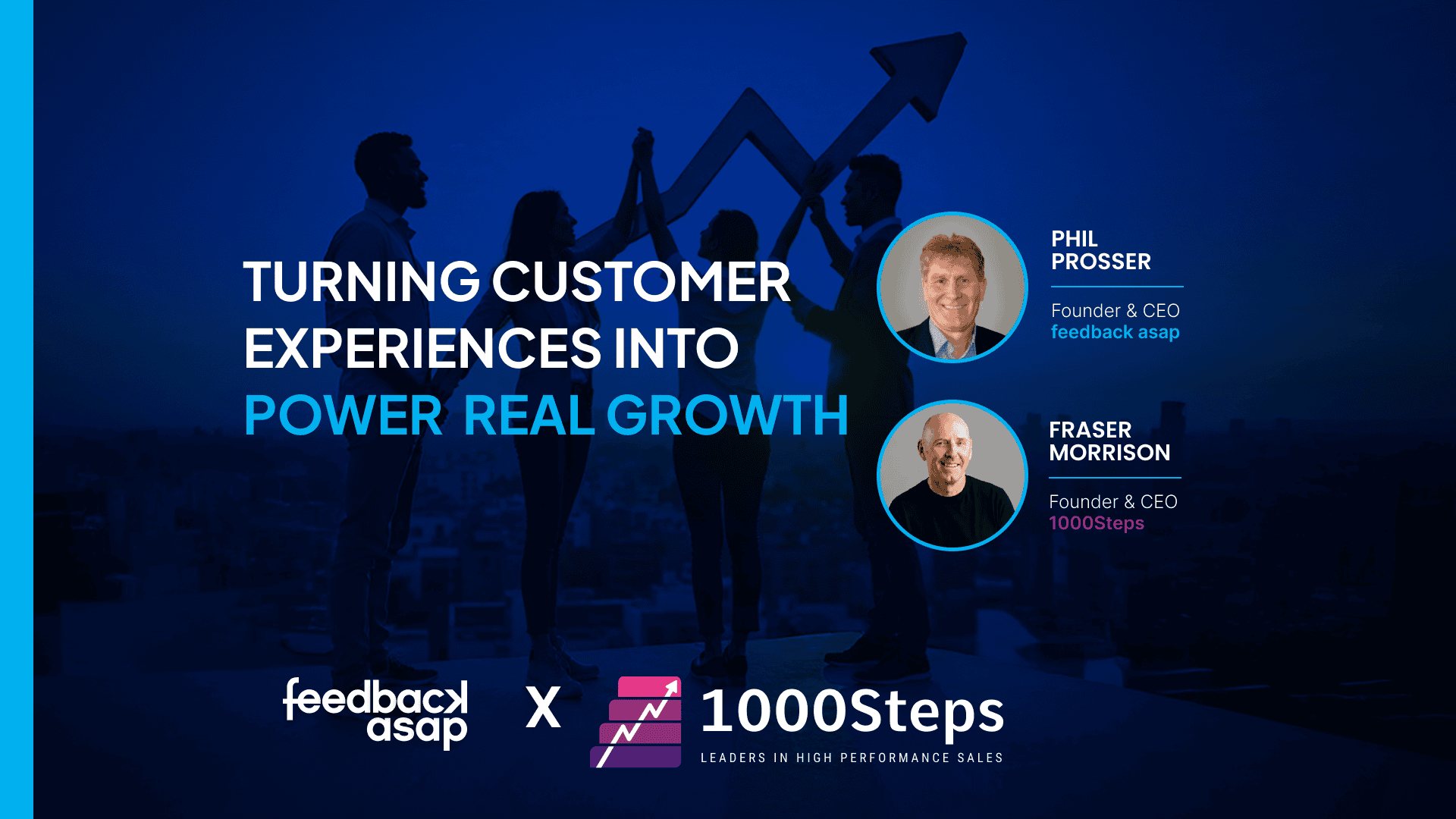
Tuesday 26 August 2026, 3:00 PM AEST (Brisbane). Free 45-minute session. Full event details.

Where it started
Julian: Phil, you’ve been doing this for more than 25 years. Before we get into the webinar, I want to ask you something I’ve never actually asked you properly. What was the moment that got you hooked on customer experience?
Phil: It genuinely was one dinner. I was Head of Marketing when we launched what became a billion-dollar retail business in New Zealand. There was an American company that was measuring customer experience in the moment, not through a survey sent three days later, but right there, while the conversation was still warm. I was fascinated. So I boarded a flight to Atlanta and ended up at dinner with Walmart’s Head of Customer Experience. I walked away thinking: this is the most powerful thing a business can do. Not marketing, not product. Understanding and improving the actual experience the customer has, in real time, and doing something about it.
Julian: And that became Shop’n Chek, which became GAPbuster, which eventually became Feedback ASAP. But the mission hasn’t really changed, has it?
Phil: The tools have changed enormously. When I started, capturing customer voice meant mystery shoppers. Now we capture video feedback, voice, text, real, unscripted reactions from real customers within minutes of an experience. But what we’re trying to do is exactly the same as it was in Atlanta. Close the gap between what a brand promises and what the customer actually experiences. Every single thing we build is in service of that.
The problem with NPS in 2026
Julian: You’re doing a webinar called “Is Your NPS Score Actually Growing Your Business?” That’s a pretty pointed question to ask in 2026, given that NPS has been the dominant CX metric for decades. What’s your honest view on it?
Phil: NPS is a useful signal. I want to be clear about that. But it was never designed to be a growth strategy, and that’s how most businesses are using it. They’ve built an entire program around a single number, and they’re surprised when the number goes up and sales don’t follow. The score went up. So why didn’t sales?
Julian: Why do you think businesses keep defaulting to it?
Phil: Because it’s simple. A CEO can look at one number and feel like they understand what’s happening. The problem is that simplicity is an illusion. NPS tells you that something happened. It doesn’t tell you what, it doesn’t tell you why, and it definitely doesn’t tell your frontline team what to do differently tomorrow morning. A 72 NPS doesn’t change a single behaviour on the shop floor. A real customer on video talking about why they almost walked out the door does.
NPS tells you that something happened. It doesn’t tell you what, it doesn’t tell you why, and it definitely doesn’t tell your frontline team what to do differently tomorrow morning.
Julian: You often talk about businesses being “data rich and action poor”. That phrase always lands with me. Can you unpack it?
Phil: Most businesses have more data about their customers than they have ever had. But the data sits in a dashboard in head office. The frontline manager who could actually do something with it never sees it. And even when they do, they’re looking at 14 different KPIs and have no idea where to start. We see this pattern constantly. Five different teams, CX, Ops, HR, marketing, training, all working from different data, pointing in different directions, and nothing actually changes at team level. That’s data rich and action poor. You’ve invested in understanding the customer and got nothing back from it commercially.
Julian: And what does it cost? I imagine most businesses don’t actually know.
Phil: We worked with a 700-store retailer where we could measure the gap between their top and bottom 20% of stores in average transaction value. That gap was 145%. Same brand. Same product range. Same price points. Different culture, different behaviour, different results. That gap exists in almost every multi-site business in the world. They just don’t know the size of it. That’s what data rich and action poor costs you. It’s not theoretical. It’s sitting in your numbers right now.
The ASAP Growth Pathway
Julian: You’ve built something called the ASAP Growth Pathway as the framework for the webinar. Walk me through it.
Phil: ASAP stands for Accelerating Improvement, Sales Growth Advantage, Accentuating Advocacy, and People, Personalisation and Productivity. Each of those is a pathway in its own right. But the point is that they’re aligned. They compound on each other. Most businesses work on one of them and wonder why the results don’t stick. When all four are running together, the growth is a different order of magnitude.
Julian: Let’s take them one at a time. What does Accelerating Improvement actually mean in practice?
Phil: It means bringing Ops, HR and marketing into the same program, not three separate programs pulling in three separate directions. It means building action habits through eLearning, coaching and reward and recognition that are linked to real customer feedback, not generic training. It means every team has a clear standard of excellence and knows exactly what their number-one opportunity is to close the gap. When you’ve got that running, improvement is a daily habit. Without it, it’s a quarterly review that nobody reads.
Julian: Sales Growth Advantage, how does CX connect to the commercial numbers?
Phil: Directly. When every team has their one specific priority, not a report, one actionable opportunity personalised to them, ATV goes up, conversion goes up, upsell goes up. We track instore and online traffic patterns, sales per hour, new customers, existing customer retention. The S in ASAP is where the board pays attention, because this is where the program shows up in revenue. And it does. The data is consistent across the industries we work in.
The S in ASAP is where the board pays attention, because this is where the program shows up in revenue.
Julian: Accentuating Advocacy is interesting to me because it’s a shift from thinking about the customer who’s standing in front of you to thinking about the customers who haven’t walked through the door yet.
Phil: That’s exactly it. And this is where I think most CX programs are leaving the most money on the table. An advocate, a customer who genuinely recommends you, is worth four to eight times the lifetime value of a non-advocate. They churn less. They spend more. They bring you new customers at close to zero acquisition cost. In one retail program we analysed, the top 20% of stores had 45% new customers in a given period. Of those, 78% came via referral or because of strong online reviews. The bottom 20% had 15% new customers. Only 32% came via referral. Same brand. One is building an advocacy engine. The other is not.

Julian: And One Voice is the tool that brings all of that together?
Phil: One Voice is how you stop managing customer experience in silos. Google reviews, call centre data, social feedback, complaint channels, HR surveys, they all tell you something. But they’re usually sitting in different systems, owned by different teams, with nobody joining the dots. One Voice unifies that into one improvement picture. You can see the cause of churn. You can see what drives advocacy. You can see the gap between your best and worst performing teams, across every feedback source at once. That’s when you stop guessing and start acting.
Julian: The P, People, Personalisation and Productivity. For me this is the most important one, because nothing changes without behaviour change at team level.
Phil: You’re right. And this is where most programs fail. They build a beautiful system and then wonder why nobody’s using it. Behaviour change happens when it’s personal. When a team member hears a real customer, on video, in their own words, explaining why they almost didn’t come back, something shifts. It’s not a score. It’s a person. And when you pair that with one clear, personalised action, not 14 KPIs, one specific thing this team can do differently, ownership replaces excuses. That’s People, Personalisation and Productivity. It’s the layer that makes everything else stick.
Why advocacy is where this is all heading
Julian: The big idea in your webinar is that advocacy is the future of CX as a growth strategy. Say more about that.
Phil: Advocacy isn’t a marketing add-on. It’s the clearest signal we have that a customer experience program is actually working. If your customers are genuinely recommending you, in their own words, to people they care about, that means the experience was good enough to stake their own credibility on. That’s the highest bar there is. And the commercial case is overwhelming. Word of mouth is trusted by 88% of people above all other forms of marketing. Referred customers churn 18% less. Advocates generate 67% more revenue than non-advocates over their lifetime. A 12-point increase in customer advocacy, according to Bain, can double revenue growth. This is not a soft metric. It’s the growth metric.
Julian: You’ve shared data about the standards of excellence and how they connect to NPS and advocacy. That link between inputs and outputs is something I don’t think many businesses have made clearly.
Phil: It’s one of the most important things we’ve been able to demonstrate. When all standards are met, NPS is around 96. Miss one standard and it drops to 82. Miss two and it’s 67. Miss three and it’s 31. Every missed standard has a dollar value. Missing just two costs you 16% of average transaction value. Missing four or more costs you 28%. Once you can see that connection, between the behaviour of the team and the commercial outcome, you can stop managing activities and start managing results. You know exactly which standards to focus on because you know exactly what they’re worth.
Every missed standard has a dollar value. Once you can see that connection, you stop managing activities and start managing results.
Julian: Is there a moment in your career that captures why this matters to you personally?
Phil: There are many. But the one that comes back to me is a store manager, this was early on, who had been running the same way for years. Good person, tried hard, genuinely cared. We showed him a video of a customer explaining, in her own words, that she felt like nobody had bothered to understand what she actually needed. He watched it and he didn’t say anything for a moment. Then he said: I thought we were doing that. We had the conversation he needed to have. And within three months, his team’s numbers had moved significantly. Not because we gave him a new dashboard. Because we gave him the real voice of a real customer. That moment, when a leader actually hears it, is what everything we do is trying to create, at scale.
What to expect on August 26
Julian: You’re doing a live webinar on August 26. I know you’ve been preparing for it. What can people expect?
Phil: I want it to be a genuine conversation, not a presentation. Fraser Morrison is hosting, and we’re going to work through the real questions that CX and operations leaders are sitting with right now. Why isn’t our NPS improving our commercial results? What does a program look like that actually changes team behaviour? How do we build advocacy systematically, not accidentally? I’ll be sharing real data, real case studies, and the ASAP framework in detail. And I want people to leave with one thing they can do in the next 30 days, even if they’re not ready to change everything at once.
Julian: Who should come?
Phil: Anyone who owns a CX program or a performance improvement program and is not satisfied that it’s moving the commercial needle. Marketing executives who want to understand why their advocacy numbers aren’t growing. Operations leaders who are frustrated that their teams have the data but not the results. Chief Customer Officers who want to make the case to the board that CX is a growth function, not a cost centre. It’s a free 45-minute webinar. If any of this conversation has resonated, it’s worth the time.
Julian: Last question. You’ve spent 25 years doing this. What’s the one thing most businesses still get wrong?
Phil: They measure to report. They don’t measure to improve. The data exists. The customer voice exists. The gap between their best and worst performing teams exists and is costing them real money every day. But the program is designed to produce a report, not to change a behaviour. When you flip that, when the program exists to give every team their one next action, connected to real customer voice, with a rhythm of accountability around it, everything changes. That’s what we’ve spent 25 years building. And it still surprises me how rarely it’s done.
Join Phil Prosser live — Tuesday 26 August 2026
Is Your NPS Score Actually Growing Your Business?
Tuesday 26 August 2026, 3:00 PM AEST (Brisbane). A free 45-minute webinar hosted by Fraser Morrison.
Worth a conversation? phil@feedbackasap.com | +61 402 533 333
About the speakers
About Phil Prosser
Phil Prosser is the Founder and CEO of Feedback ASAP. More than 25 years ago, a dinner with Walmart’s Head of Customer Experience in Atlanta changed the direction of his career. He brought the concept of real-time CX improvement to Australia and New Zealand, built Shop’n Chek into GAPbuster, one of the world’s leading CX improvement partners, and today runs Feedback ASAP with a team operating across 74 countries and over 200 million customer moments.
About Julian Barton
Julian Barton is EGM at Feedback ASAP. He has worked alongside Phil Prosser for 17 years across two companies, and leads the business’s sales strategy, marketing and content output across Australia, New Zealand and North America.
FAQs
What is the ASAP Growth Pathway?
It is Feedback ASAP’s framework connecting four pathways, Accelerating Improvement, Sales Growth Advantage, Accentuating Advocacy, and People, Personalisation and Productivity, so that customer feedback drives measurable business growth rather than just reporting.
When is the “Is Your NPS Score Actually Growing Your Business?” webinar?
Tuesday 26 August 2026 at 3:00 PM AEST (Brisbane time). It is a free 45-minute session hosted by Fraser Morrison, featuring Phil Prosser, Founder and CEO of Feedback ASAP.
Who should attend?
Anyone who owns a CX program or performance improvement program, including marketing executives, operations leaders, and Chief Customer Officers who want to connect customer feedback to commercial growth.
Is there a cost to attend?
No, it is a free 45-minute webinar.
Who is presenting?
Phil Prosser, Founder and CEO of Feedback ASAP, in conversation with host Fraser Morrison.